The foreign exchange market operates 24 hours a day, five days a week, making it nearly impossible for individual traders to monitor every opportunity. This challenge has led many retail traders to explore automated solutions. Two terms frequently appear in these discussions: AI forex bots and forex robots. While these terms are often used interchangeably, understanding their differences can help traders make more informed decisions about which tools might fit their trading approach.
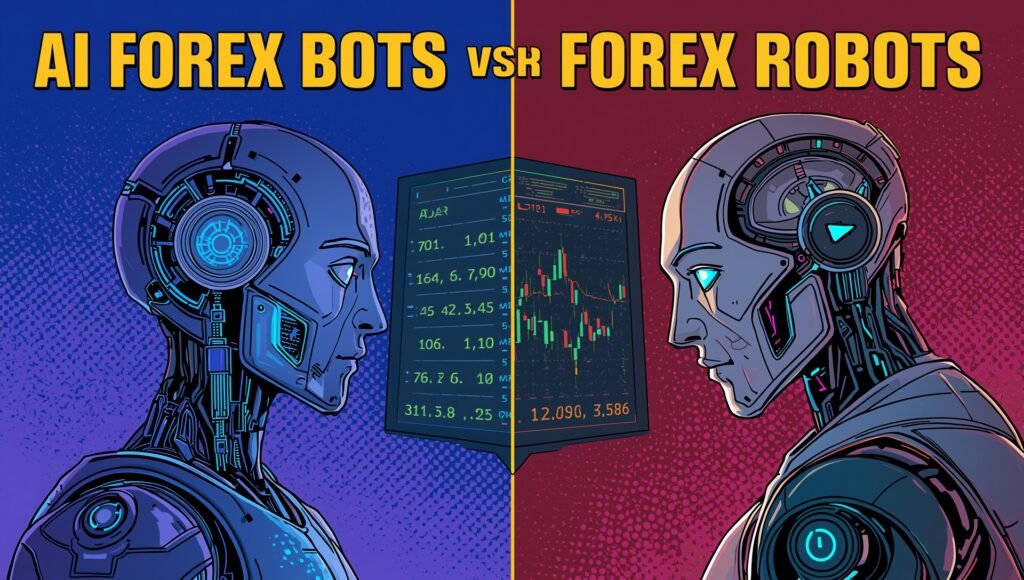
AI forex bots use machine learning to adapt to changing market conditions, while traditional forex robots follow fixed rules programmed by developers. Both execute trades automatically, but AI systems can potentially adjust strategies based on new data patterns.
Understanding Traditional Forex Robots
A forex robot is software programmed to execute trades based on predetermined rules and technical indicators. These systems follow specific instructions without deviation. For example, a forex robot might be programmed to buy EUR/USD when the 50-day moving average crosses above the 200-day moving average, then sell when the opposite occurs.
Traditional forex robots operate on “if-then” logic. They scan currency pairs for specific conditions and execute trades when those conditions are met. This approach has been available to retail traders for over a decade, with many systems running on platforms like MetaTrader 4 and MetaTrader 5.
The key characteristic of traditional forex robots is their static nature. Once programmed, they continue executing the same strategy regardless of changing market conditions. They cannot learn from past trades or adjust their approach based on new information. This consistency can be both a strength and a limitation, depending on market conditions.
How AI Forex Bots Differ From Traditional Systems
An ai forex bot represents a more recent development in automated forex trading technology. These systems incorporate machine learning algorithms that can analyze large amounts of historical and real-time data to identify patterns that might not be obvious to human traders or traditional robots.
The primary distinction lies in adaptability. While traditional forex robots follow fixed rules, AI systems can potentially adjust their parameters based on performance data and changing market conditions. They process information differently, using neural networks or other machine learning techniques to recognize complex patterns across multiple timeframes and currency pairs.
AI forex bots typically analyze more variables simultaneously than traditional systems. They might consider factors like market volatility, correlation between currency pairs, news sentiment, and historical price patterns all at once. This broader analysis approach differs from the more focused technical indicator approach used by traditional robots.
It’s important to note that neither system guarantees profits. All trading involves risk, and past performance does not indicate future results. The sophistication of AI technology does not eliminate the inherent risks of forex trading.
Key Differences in Performance and Flexibility
When comparing these two approaches to automated forex trading, several practical differences emerge:
Learning Capability Traditional forex robots cannot learn from their trades. If market conditions change and the robot’s strategy becomes less effective, it continues executing the same approach until a human operator modifies the code. AI forex bots can potentially identify when their current approach is underperforming and adjust certain parameters within predefined limits.
Data Processing Forex robots typically monitor a limited set of technical indicators. An best ai trading bot can process significantly more data points, including non-traditional inputs like trading volume patterns, market sentiment indicators, and correlations across multiple assets.
Strategy Complexity Traditional systems work best with straightforward strategies based on clear technical signals. AI systems can handle more complex, multi-layered strategies that consider numerous factors simultaneously.
Optimization Requirements Forex robots require manual optimization. Traders must backtest different parameter combinations and periodically adjust settings as market conditions evolve. AI systems can perform some optimization internally, though human oversight remains important.
| Feature | Traditional Forex Robot | AI Forex Bot |
| Learning ability | None – follows fixed rules | Can adapt based on data patterns |
| Data processing | Limited technical indicators | Multiple data sources simultaneously |
| Strategy adjustment | Requires manual reprogramming | Can modify within set parameters |
| Setup complexity | Generally simpler | Often more complex initial setup |
| Transparency | Clear rule-based logic | Decision process can be less transparent |
Practical Considerations for Retail Traders
Choosing between these approaches involves weighing several practical factors beyond technical capabilities.
Cost and Accessibility Traditional forex robots are often less expensive than AI-powered solutions. Many are available for one-time purchases or modest monthly subscriptions. AI forex bots typically require more computational resources and may come with higher subscription costs, though platforms like Korvato aim to make these technologies more accessible to everyday users.
Technical Knowledge Required Forex robots generally require less technical expertise to set up and operate. Most come with straightforward installation instructions and preset configurations. AI systems may require more initial learning to understand how to properly configure risk parameters and monitor performance.
Risk Management Both systems require careful risk management settings. Users must set position sizes, stop-loss levels, and maximum drawdown limits. Neither system should be operated without these safeguards. With AI forex bots, understanding how the system makes decisions can be more challenging, making risk parameter settings even more critical.
Market Conditions Traditional forex robots often perform best in trending markets where their programmed patterns are most likely to appear. They may struggle during ranging or highly volatile periods. AI systems may handle varying conditions better due to their adaptive nature, though this advantage is not guaranteed.
Monitoring Requirements No automated system should run completely unattended. Both forex robots and AI forex bots require regular monitoring to ensure they’re functioning properly and not exposing accounts to excessive risk. Market conditions can change rapidly, and technical issues can occur with any software.
Realistic Expectations and Risk Awareness
Retail traders exploring automated forex trading must maintain realistic expectations regardless of which technology they choose.
The forex market is highly competitive, with institutional traders, banks, and hedge funds all competing for profits. No automated system—whether a traditional forex robot or an ai forex bot—can guarantee consistent profits. All trading involves substantial risk, and traders can lose their entire investment.
Marketing materials for both types of systems often show impressive backtested results. However, backtested performance does not predict future results. Market conditions change, and strategies that worked in the past may not work going forward. This applies equally to traditional and AI-based systems.
When evaluating any automated forex trading system, consider these points:
- Understand that all trading involves risk of loss
- Start with small position sizes while learning how the system operates
- Never invest more than you can afford to lose
- Maintain realistic profit expectations
- Keep detailed records of system performance
- Be prepared to intervene if the system behaves unexpectedly
- Verify that you understand all fees and costs involved
Companies offering these tools, including fintech providers, do not offer financial advice. Users are responsible for setting their own risk levels and making their own trading decisions.
Making an Informed Choice
The decision between traditional forex robots and AI forex bots depends on individual circumstances, technical comfort level, and trading goals.
Traditional forex robots offer simplicity and transparency. Their rule-based approach makes it easier to understand exactly why trades are executed. They work well for traders who prefer straightforward strategies and want clear control over their trading logic.
AI forex bots offer potential advantages in adaptability and data processing. They may better handle complex market conditions and identify patterns that simpler systems miss. However, they come with added complexity and often higher costs.
Some retail traders use both approaches, running traditional systems for specific strategies while exploring AI tools for different market conditions or currency pairs. This diversified approach allows comparison of performance across different methodologies.
Regardless of which path you choose, thorough research is essential. Test any system with demo accounts before risking real capital. Understand the technology’s limitations as well as its capabilities. And remember that no automated system eliminates the need for ongoing education about forex markets and trading principles.
The evolution from traditional forex robots to AI forex bots represents technological progress in automated trading tools. However, technology alone does not determine trading success. Proper risk management, realistic expectations, and continuous learning remain the foundation of any trading approach—automated or manual.